
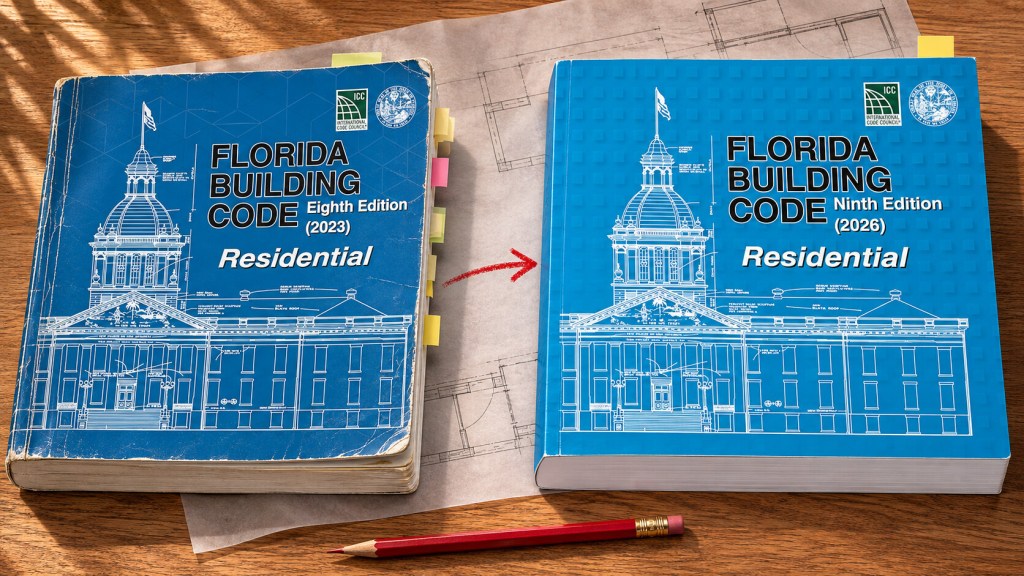
If your new home, addition or renovation is approaching permit submittal, put December 31, 2026 on the project calendar. Florida’s Ninth Edition of the Building Code takes effect that day as part of the state’s three-year update cycle. Under Florida law, the building permit application date determines which edition governs the work for the life of the permit, including granted extensions. A zoning approval alone does not establish that date.
Dade County adopted the South Florida Building Code in 1957. Hurricane Andrew exposed weaknesses in construction and enforcement in 1992, and the final edition of that regional code took effect in 1994. Florida called for a single statewide code in 1998 and authorized its implementation in 2000. The first statewide edition took effect on March 1, 2002.
Florida has some of the country’s toughest hurricane-related building standards. In 2024, the Insurance Institute for Business & Home Safety ranked Florida second among 18 Atlantic and Gulf Coast states for its residential code system. Miami-Dade and Broward are in the High-Velocity Hurricane Zone. If you’re selecting windows or exterior doors here, a Miami-Dade Notice of Acceptance (NOA) identifies the specific assembly and its installation limits. Other jurisdictions also recognize these approvals. Our 2016 guide to Notices of Acceptance explains the process. Check the county’s current product database for the model you plan to use.
Three changes for coastal homes
Three changes in Greenberg Traurig’s overview are worth a homeowner’s attention. The first is flood elevations on the drawings. For a new home in a flood hazard area, the plans must show both the base flood elevation and the proposed elevation of the lowest floor. That difference matters when you design the entry stairs or connect a terrace to the yard. The second concerns open-sided structures. Section 1612.4.4 of the Building Code volume adds flood provisions for gazebos, platforms, and boat shelters, among others. Include these in the flood review when you lay out a waterfront property.
The third change is easy to miss once the walls are closed. Within 3,000 feet of a saltwater coastline, new rules address corrosion resistance for fasteners and metal connectors. Distance from the coastline and exposure to salt air determine which metals or coatings are suitable. For a covered terrace, ask the design team to specify both the connectors and their fasteners before the contractor prices them. See Section R332 in the Commission’s residential code comparison.

If your drawings are nearly ready, confirm what your building department needs for a complete application. Miami-Dade County’s online portal applies the new edition to submissions received after 4 p.m. on December 30. Municipal building departments may have different cutoffs. For an Owner Advisory consultation, contact Sebastian Eilert Architecture. We can review your drawings and filing schedule together so you know whether to submit this December or plan for the new edition.


Leave a Reply