
By James Lin, Manager, Miami House Cleaning
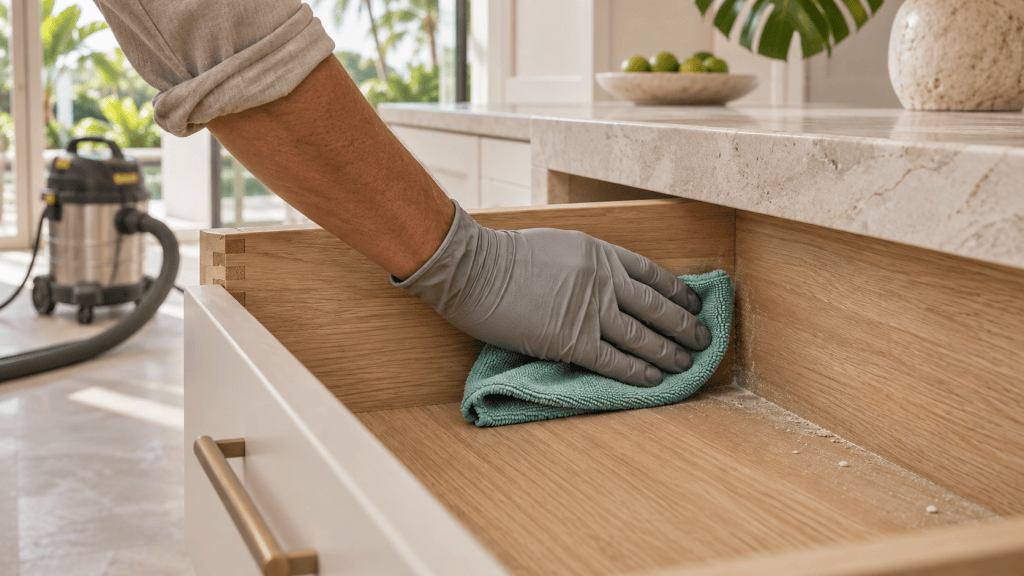
The last trade packs up, the contractor hands you the keys and says the house is “broom clean.” Two weeks later you run a finger along the top of a door frame and it comes back white. You open a kitchen drawer and there is a fine grey line in every corner. The air handler is pushing something you can smell but cannot see.
This is the part of a remodel nobody budgets for, and it is the part we get called for most. After more than 100 post-construction cleans across Miami-Dade, Broward and Palm Beach, here is what we wish every homeowner knew before the demo started.
What construction dust actually is
“Dust” is a polite word for a mix of materials that do not behave like ordinary house dust:
- Drywall and joint-compound fines. Gypsum sanding dust is light enough to stay airborne for hours and settle long after the crew has left. It is the white film you find on everything a week later.
- Silica from concrete, tile and stone cutting. Heavier than gypsum, it sits in grout lines, on sills and in floor-tile texture. It is also the one you least want to breathe.
- Wood dust, insulation fibers and paint overspray. These cling to vertical surfaces, cabinet interiors and the undersides of shelves, where a quick wipe never reaches.
- Adhesive, grout and caulk haze. Not dust at all, but a residue that ordinary cleaners smear instead of lifting.
The reason it keeps “coming back” is simple: it was never gone. It was sitting inside cabinets, on top of ceiling fans, in window tracks, behind the refrigerator and, most often, in the air-conditioning system, which redistributes it every time the compressor kicks on.
What “broom clean” means in your contract
Most residential construction contracts promise the site will be left “broom clean” or “free of debris.” That is a real standard, but a low one. It means the contractor’s crew hauls out its own materials, sweeps the floor and takes the labels off the fixtures. It does not mean the home is ready to live in.
Nothing in that clause covers the inside of your new cabinets, the dust on top of your crown molding, the film on every window or the filter in your air handler. Many contractors subcontract the real final clean to a cleaning company or leave it to the homeowner entirely. Ask which one applies to you before you sign, and get the answer in writing. If you want to see what a professional final clean is expected to cover on a contractor’s schedule, the scope we work from for general contractors is a fair checklist for a homeowner too.
Six things to demand from your contractor’s crew
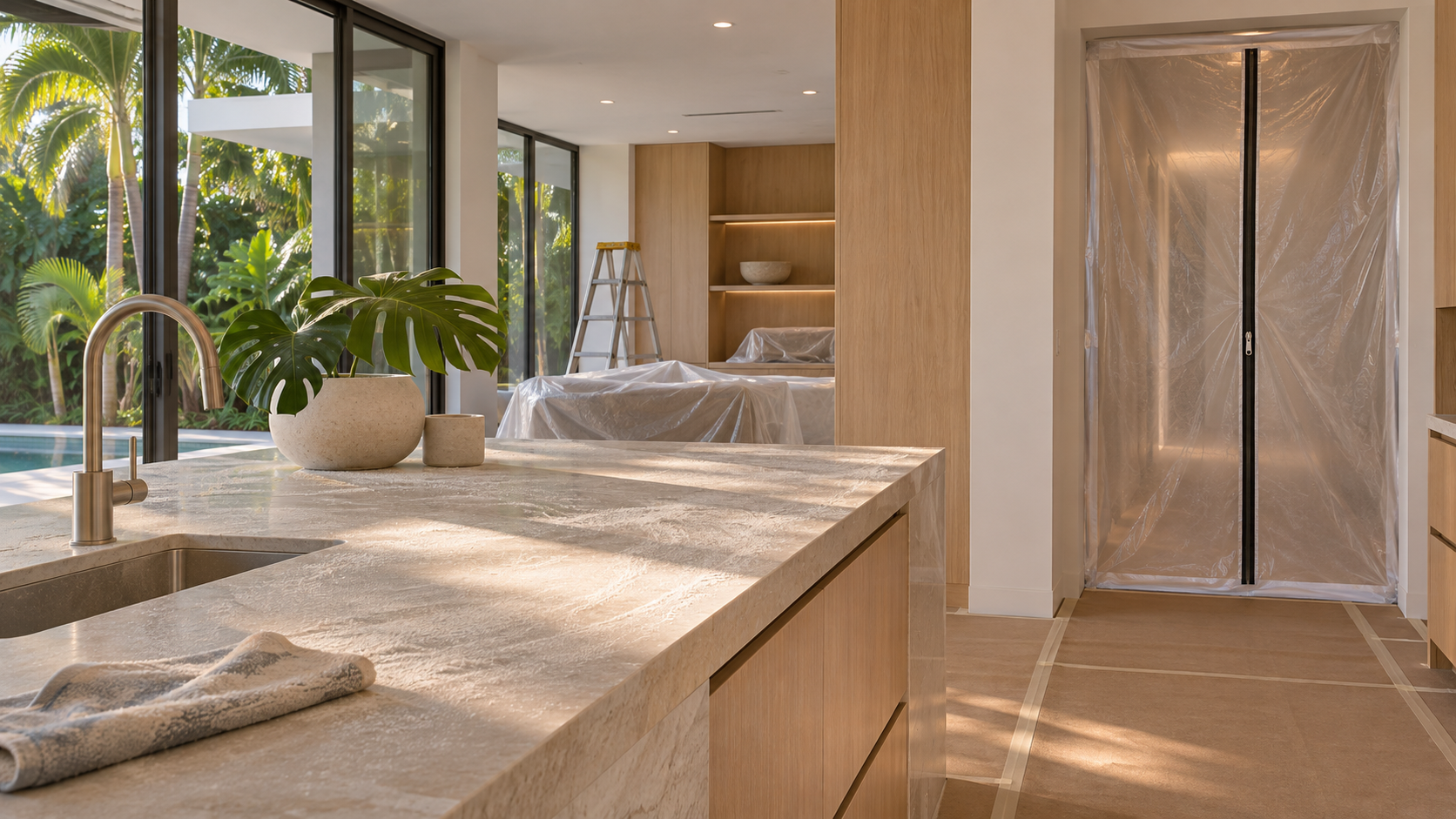
- Containment while the dust is being made. Plastic sheeting and zipper doors on every opening into the finished part of the house, taped at the floor. On a larger job, a negative-air machine venting outdoors. This is cheap and it is the single biggest factor in how much cleanup you face.
- Protect the air-conditioning system. Supply and return registers sealed, the system switched off during sanding and cutting, and a new filter installed before the crew leaves. If the system ran during drywall work, ask for the ducts to be inspected.
- A rough clean after the last dust-producing trade. Drywall, sanding, tile and flooring should be followed by a heavy clean before painters and finish carpenters arrive. Otherwise the finishing trades grind that dust into your new surfaces.
- Their own debris out, their own stickers off. Appliance labels, window-glass stickers, tile and plumbing fixture tags are the contractor’s responsibility. So is the dumpster.
- Finished floors covered until the end. Ram board or rosin paper on wood and stone, taped seams, replaced when torn.
- A flashlight walkthrough. Walk the house with the contractor at dusk with the lights off and a flashlight held low against the floor and the counters. Dust and haze that are invisible under ceiling light show up instantly.
What is still left when the contractor leaves
Even with a conscientious crew, this is the list we find on almost every job:
- Tops of cabinets, door frames, window frames and crown molding
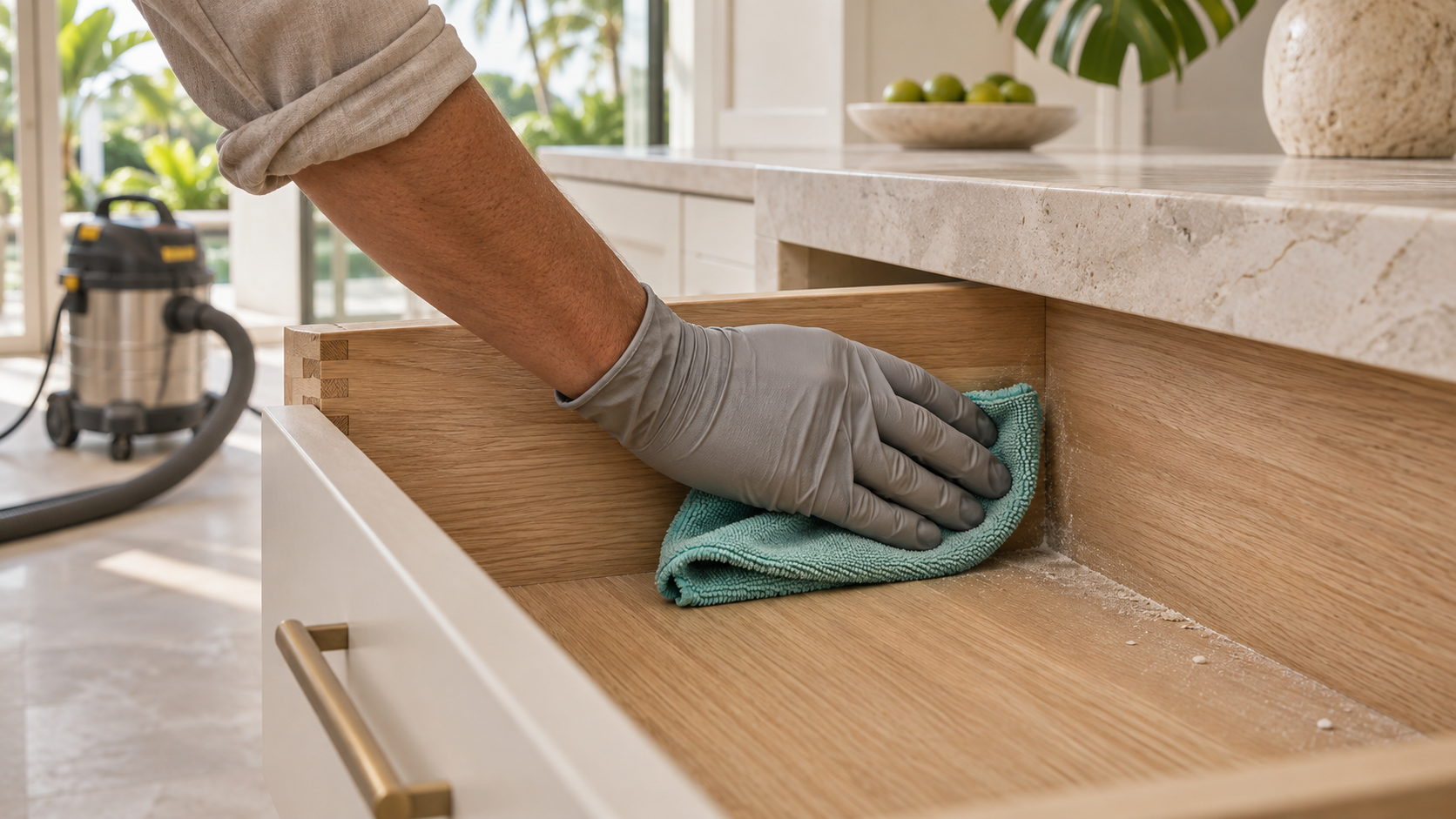
- Inside every cabinet, drawer and closet shelf
- Window tracks, sills and screens
- Light fixtures, ceiling fans and air-conditioning registers
- Grout haze on tile and stone, and paint on hardware, hinges and glass
- The gap behind and beneath appliances
- Baseboard tops and the line where the baseboard meets the floor
- Caulk lines in bathrooms and kitchens
- Soft surfaces that stayed in the house: upholstery, rugs, mattresses and blinds, all of which absorb fine dust and release it for weeks
That last point surprises people. A sofa that lived through a drywall job will shed gypsum every time someone sits on it. On larger remodels we recommend having upholstery and carpets and blinds cleaned as part of the final pass, not months later.
One clean is rarely enough on a big project
On a kitchen or bathroom remodel, one thorough clean after the last trade leaves usually holds. On a whole-home renovation or new build, it will not, because trades keep working after the cleaners leave.
We handled a recent 8,000-square-foot new build in Coral Gables in three stages: a rough clean with 15 cleaners over two consecutive days once the dust-making trades finished, a second pass with 12 cleaners after the painters’ final coats, and a six-person detail the day before the realtor staged the house. The homeowner would have paid for the first clean twice if we had tried to do it in one visit.
The full story is in our Coral Gables case study, and we published a short guide to when to schedule each stage for homeowners planning a larger project.
Doing it yourself versus hiring it out
A single-room remodel with the HVAC sealed off is a weekend job for a careful homeowner. You need a vacuum with a true HEPA filter (a shop vac without one blows the finest dust straight back into the room), damp microfiber cloths changed often, and the discipline to work top to bottom in every room. Never dry-sweep or dust with a feather duster; you are just moving it.
Hire it out when the work touched more than one room, when drywall was sanded anywhere in the house, when the air-conditioning ran during the job, when anyone in the home has asthma or allergies, or when you have a move-in, staging or photography date you cannot miss. A professional post-construction clean is cleaning only: fine dust removal from every surface, window and track detailing, cabinet and appliance interiors, fixture detailing and floor preparation. It does not include hauling the contractor’s debris, so do not let that get dropped between the two parties.
A note on air quality, especially in South Florida
For a green-minded homeowner, the cleanup phase is where indoor air quality is won or lost. Replace the air handler filter the day the crew leaves and again two weeks later; a higher-rated filter is worth it for the first month. Run the system continuously for the first few days so it captures what the cleaning stirs up. Use damp methods and low-odor cleaners rather than aerosols. And resist the instinct to throw the windows open to “air it out”: in Miami’s humidity, a house that has just had new drywall and fresh paint is the last place you want warm, wet air settling into porous surfaces. Let the air conditioning do the work.
What it costs
Post-construction cleaning is priced by finished square footage because that is what drives the labor. Our rates start at $1,500 for spaces under 1,500 square feet and scale from there, with stage-specific quotes for rough, post-paint and pre-staging work. The complete tiers are on our post-construction cleaning page, or you can request a free estimate with your square footage and the stage of the project.
The best outcome is the one where you never have to think about any of this, because you asked the right questions before the first wall came down.

James Lin is the manager at Miami House Cleaning, a Miami-based company that cleans homes, offices and newly built or renovated properties across Miami-Dade, Broward and Palm Beach counties. The company holds a 4.9-star rating across 145 verified reviews and is accredited by the Better Business Bureau.


Leave a Reply